


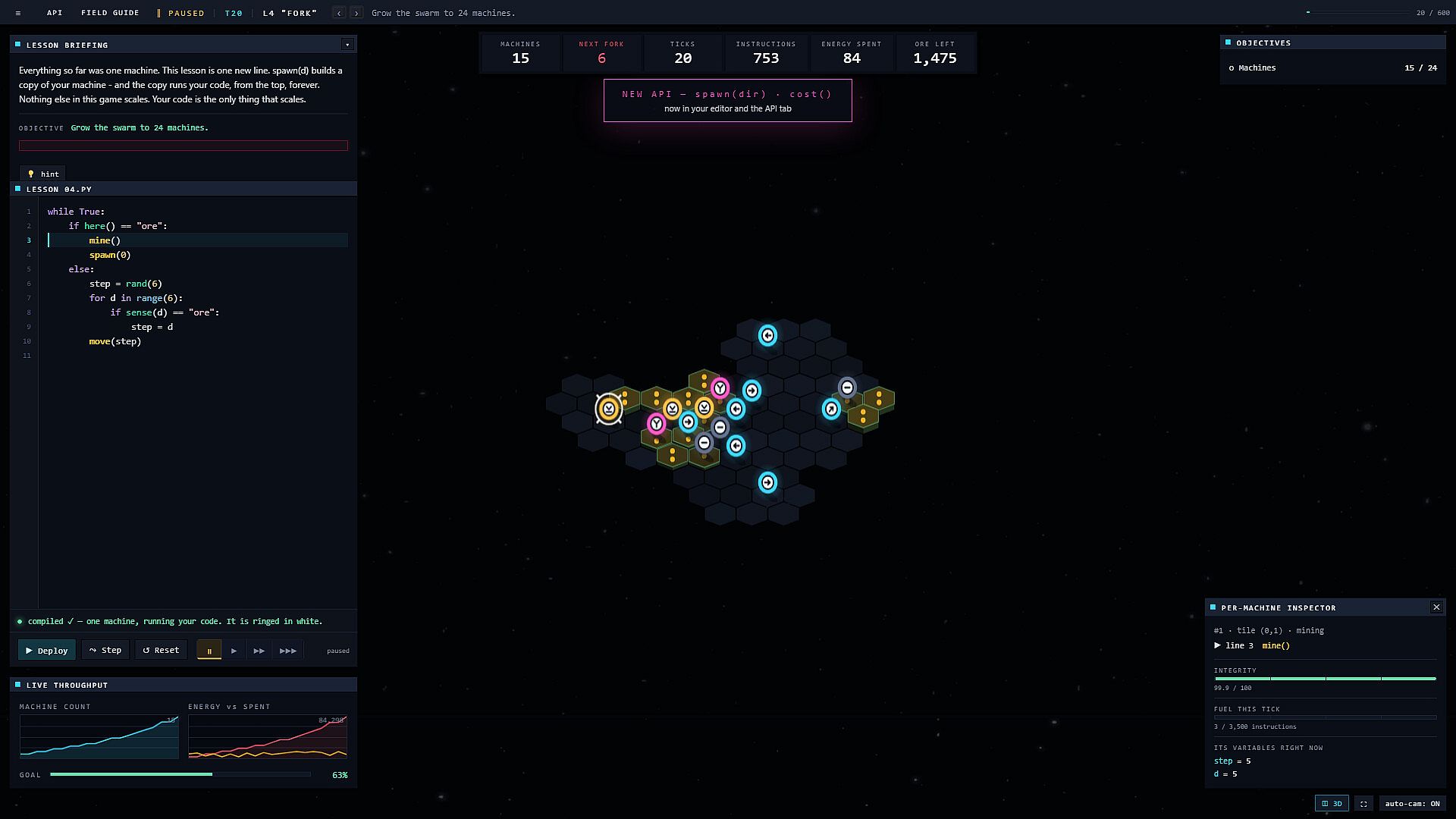
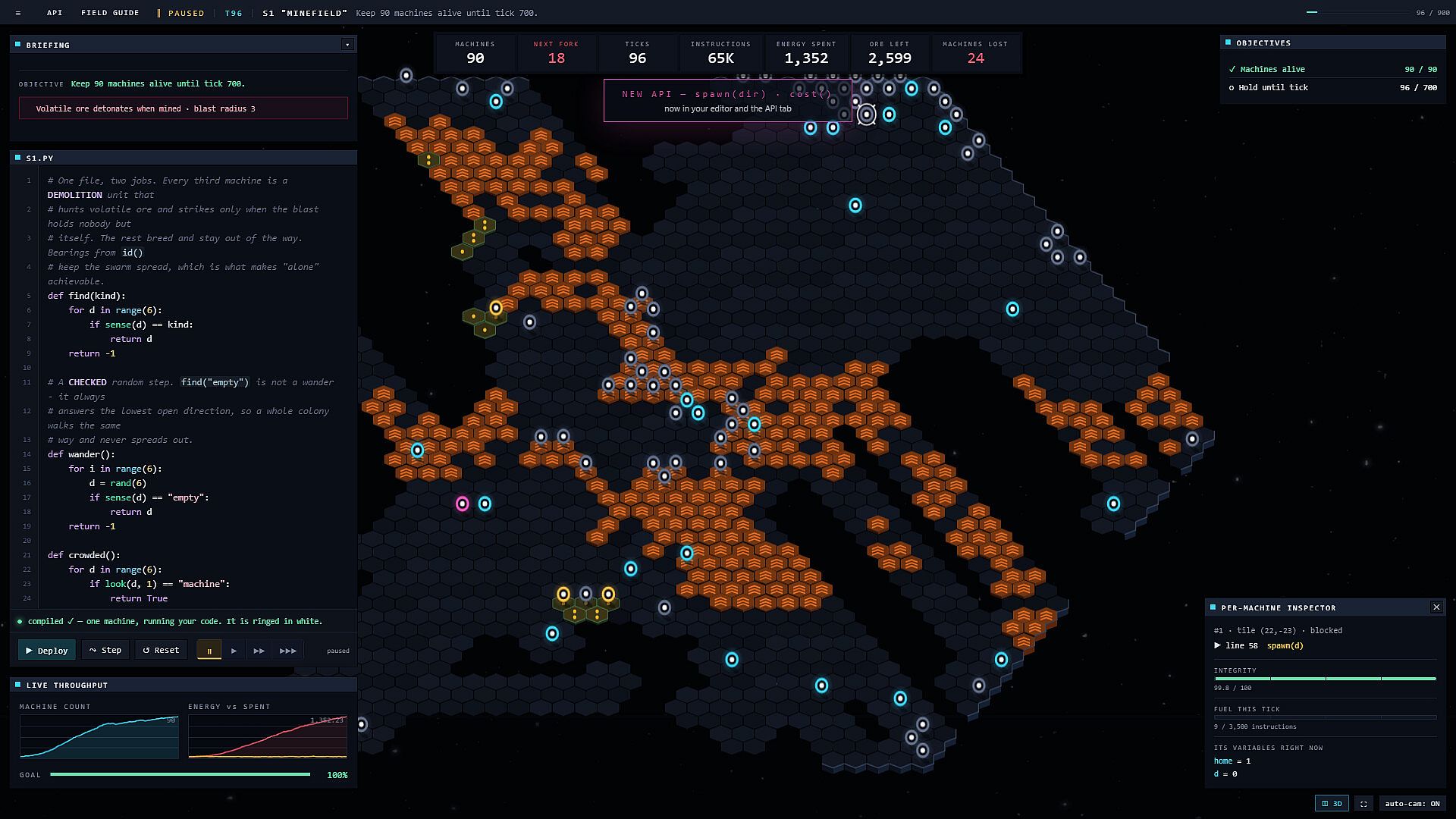
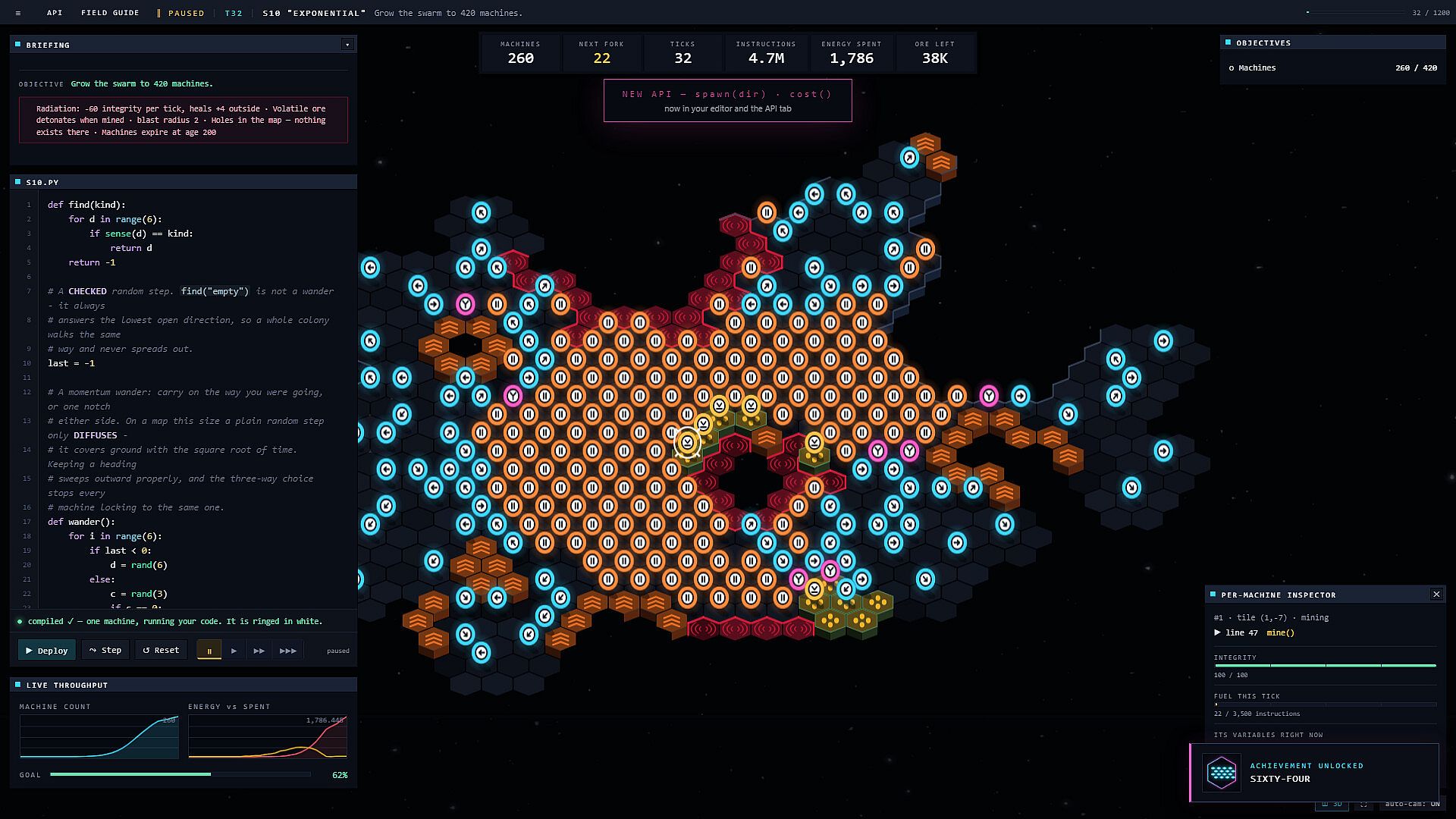
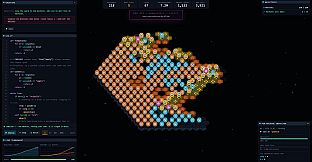
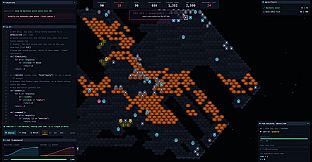
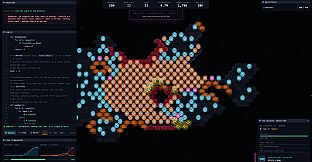
FORK BOMB: A Programming Game is a single-player strategy indie simulation title built around writing and refining code to manage self-replicating machines on a barren world. Players begin with one machine on a dead rock and a text editor, then expand a colony by teaching that machine to duplicate itself and its instructions exactly. The experience centers on incremental growth where every advance comes from new functions in a Python-like language rather than external upgrades or random events.
Gameplay
The core loop involves editing code that controls machine behavior. Each unit can move, dig for resources, sense the ground beneath it, and monitor colony energy levels. Early lessons introduce these actions one concept at a time, allowing players to modify working examples instead of starting from empty files. Once replication becomes available, the same code runs on every copy, turning a single machine into hundreds or thousands that operate in parallel across the map.
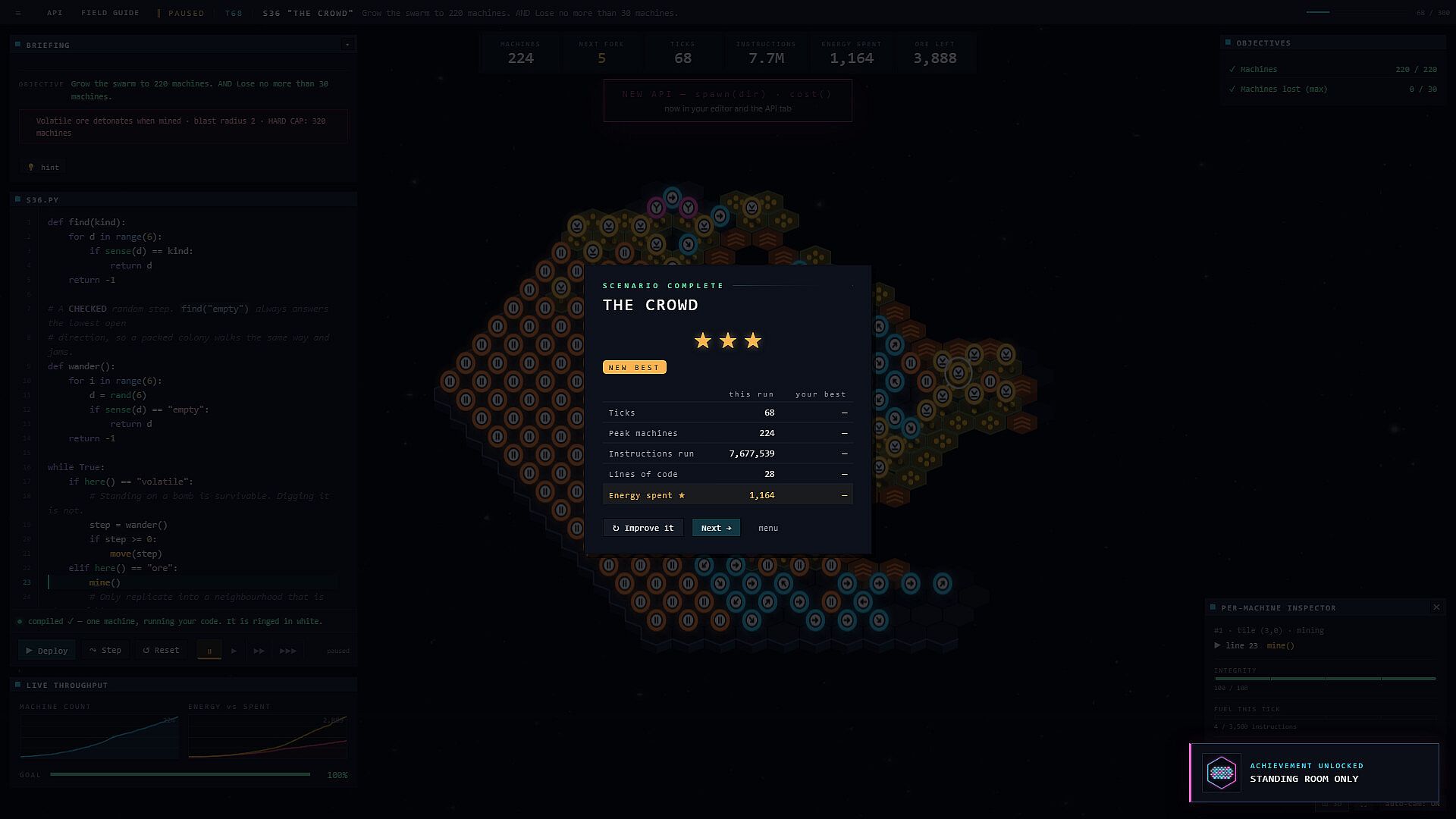
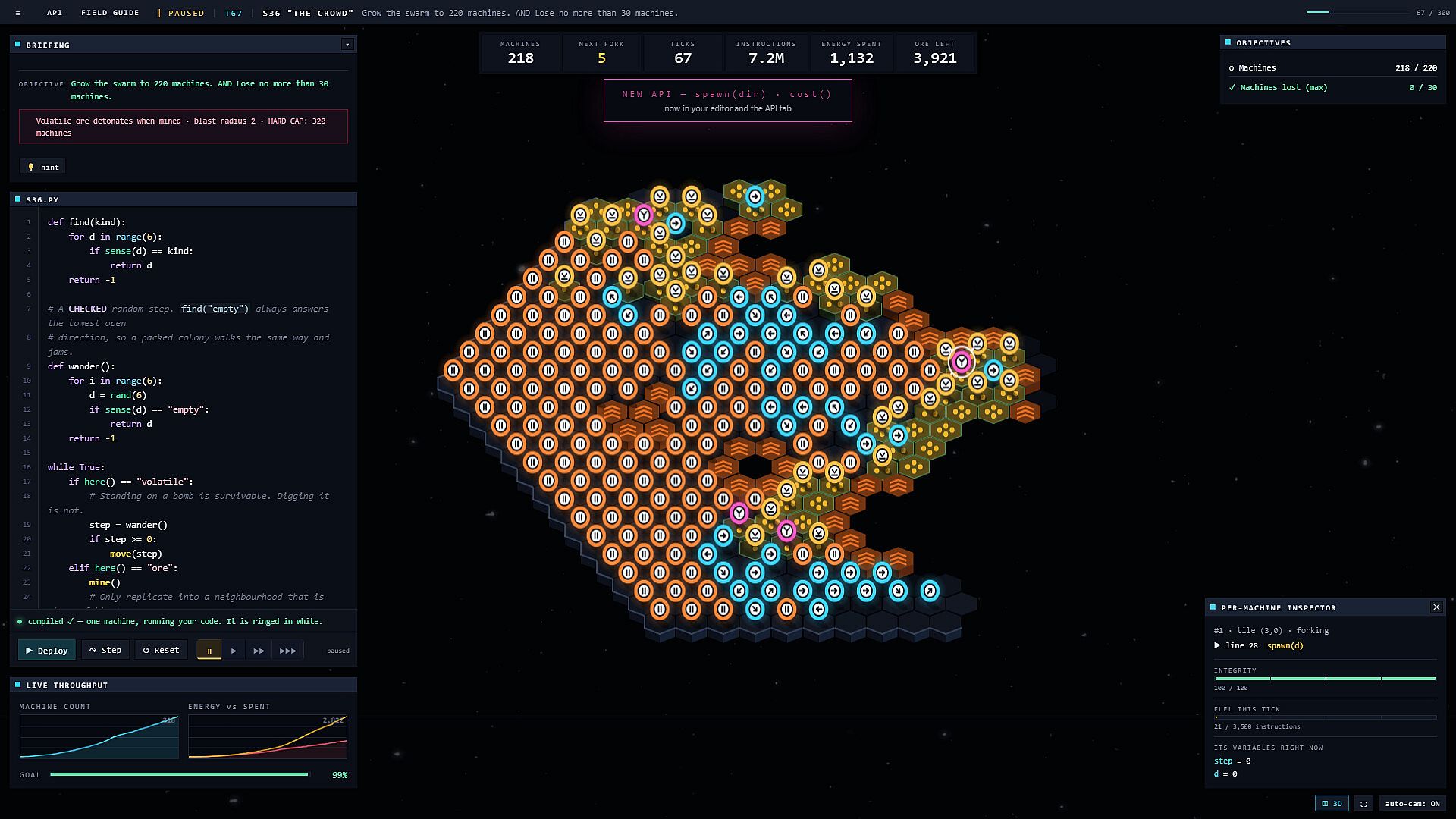
Progress depends entirely on code quality. A routine that functions with four machines often collapses at four hundred because units compete for the same ore veins, block pathways with their own bodies, or exhaust a fixed instruction budget on every tick. The simulation runs deterministically, so identical code and world seeds produce identical outcomes every time. This setup rewards careful planning and debugging while punishing inefficient loops that waste processing cycles.
Seventeen functions form the complete vocabulary. Fifteen appear across the first ten lessons, covering movement, sensing, and basic replication. The final two, send and recv, enable machine-to-machine messaging and unlock at lesson eleven. No stat multipliers or currency systems exist. Advancement comes only from expanding the set of reliable instructions a player can deploy.
Game Modes
Eleven guided lessons introduce one core idea each and provide working code to edit. These tutorials cover indentation rules, conditional logic, and the transition from single-machine control to swarm management. Thirty-nine additional scenarios follow across four tiers of difficulty. Early tiers focus on small maps and short programs, while later ones scale to a radius-sixty world where efficient solutions deploy hundreds of machines within tight time limits.
The pro tier removes tools progressively. Certain levels disable sensors, position readouts, identity tracking, or price information, forcing players to solve problems with incomplete data. A separate sandbox mode offers roughly thirty adjustable parameters, including world size, ore density and hardness, radiation levels, volatile resources, defensive turrets, terrain holes, machine lifespan, upkeep costs, instruction budgets, and selective API restrictions. Sandbox play has no objectives, allowing free experimentation with different rulesets.
Learning Through Errors
Error messages translate directly into plain English explanations that reference the exact line and concept involved. An indentation mistake, for example, receives a note about the four-space requirement that signals code belonging inside a block. The built-in API reference stays one keystroke away, searchable, and includes a worked example for every available call. It also flags which functions remain locked or have been removed by the current level. A Field Guide explains every on-screen symbol so players can interpret the simulation state without external help.
Is It Worth Playing?
This title suits players who enjoy solving problems through code rather than menus or timers. Those new to programming receive structured guidance through the first lessons before facing open challenges. Experienced coders can finish the introductory sequence in under an hour and then tackle scenarios that mirror real-world issues of scaling, resource contention, and instruction efficiency. The absence of microtransactions, multiplayer queues, or hidden randomness keeps focus on deterministic outcomes and personal code improvement.
Current Early Access status means the full set of fifty levels and sandbox options is available on PC, with the simulation running consistently across repeated runs. Growth feels earned because every additional machine results from code that actually works at scale. For anyone interested in a programming-driven strategy experience where the challenge curve comes from swarm complexity instead of artificial gates, the game delivers a focused, self-contained loop that rewards iteration and careful observation.