



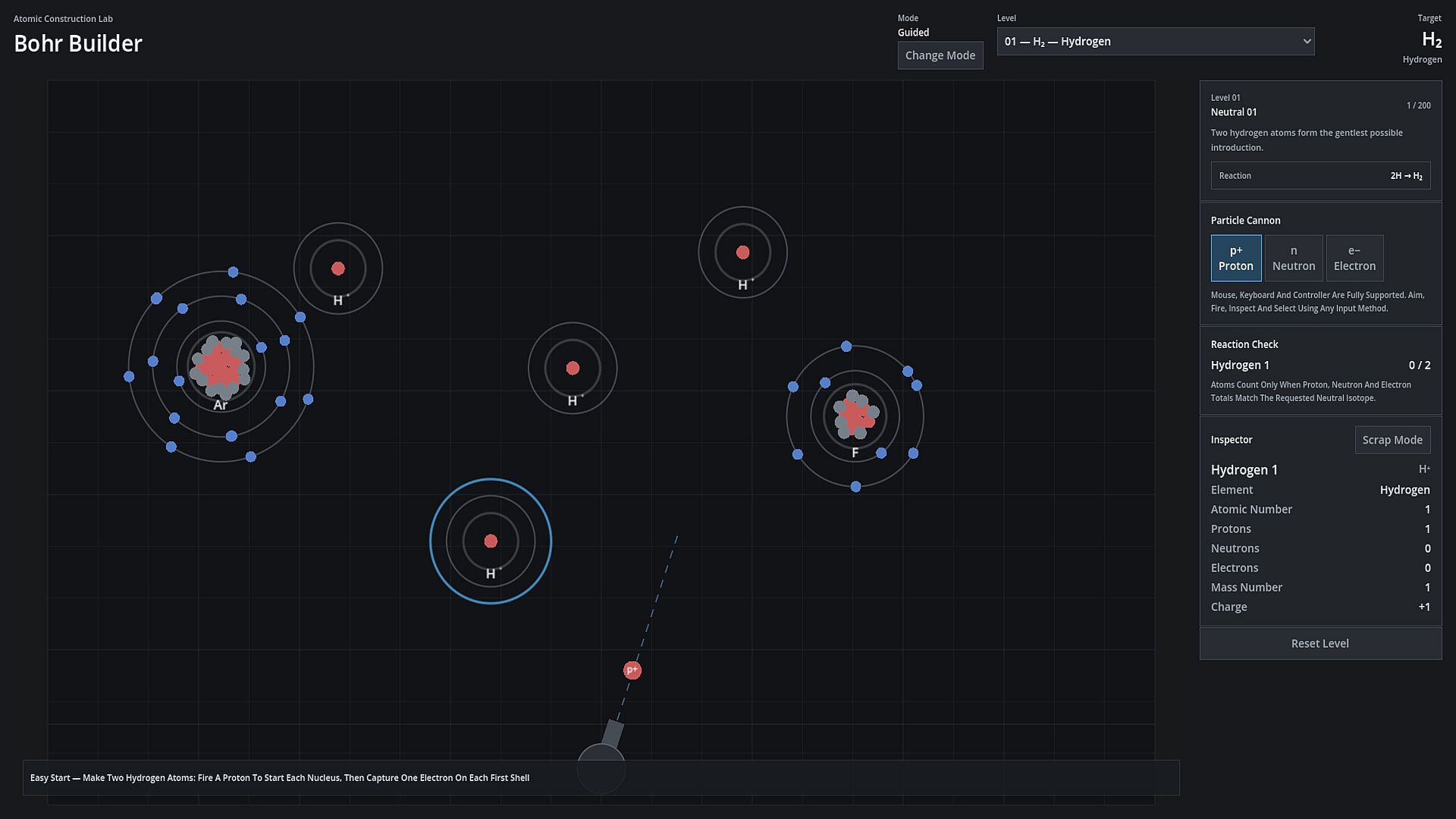
Bohr Builder is a physics simulation game that puts players in control of atomic construction on PC. Instead of selecting elements from lists, participants fire protons, neutrons, and electrons into a live workspace to assemble atoms from the ground up. The experience blends strategy, simulation, and light action elements as particles travel, collide, and respond to precise aiming.
Gameplay
Core play revolves around aiming a particle cannon and launching the three fundamental building blocks into a two-dimensional field. Protons alter the element by changing atomic number, neutrons adjust the isotope through mass changes, and electrons modify charge by filling or emptying shells. Particles move with fixed launch speed, requiring careful positioning to achieve capture in the nucleus or Bohr shells rather than bouncing away.
Success depends on understanding atomic rules in real time. A single misplaced shot can send particles off course, while accurate trajectories allow electrons to settle into shells and nuclei to stabilize. The system visualizes simplified Bohr shells, and interactions include attraction, repulsion, and capture mechanics that reward patience and spatial awareness. Every completed atom carries verifiable properties such as proton count, neutron count, electron count, mass number, and electrical charge, making the difference between species tangible rather than abstract.
Game Modes
The 200-level campaign forms the structured backbone, beginning with neutral atoms and molecular products in the first fifty levels. Later stages introduce ions, requiring balanced positive and negative charges to form stable ionic compounds. Assistance tapers off as constructions grow larger and more complex.
Two campaign variants exist. Guided Mode supplies chemical names, equations, lessons, and exact requirements to support learning. Formula Only Mode removes those aids, presenting only the target formula so players must determine required elements, quantities, charges, and particle counts independently. Both share identical underlying challenges but differ in how much chemistry knowledge the player must apply.
Freeplay functions as an open sandbox. Users create arbitrary atoms and ions, inspect their properties, clear experiments, and maintain personal collections. Multiple species can be selected as reactants to test combinations against an offline library of recognized molecular and ionic products, turning the mode into a flexible chemistry puzzle space.
Campaign Progression and Learning
The campaign steadily builds familiarity with atomic structure. Early levels emphasize fundamentals such as constructing neutral atoms and simple molecules. Mid-campaign shifts focus to ions and charge balance, while later levels demand larger, more intricate assemblies with reduced guidance. Persistent progression tracks completed work across sessions.
Learning occurs through direct interaction rather than memorization. Constructing carbon requires grasping what distinguishes it from neighboring elements. Creating an isotope reveals the effect of neutron addition. Forming an ion demonstrates how electron count produces charge. These hands-on steps replace textbook questions with practical assembly.
Is It Worth Playing?
Bohr Builder suits players interested in chemistry, physics simulations, or puzzle-style construction games. The hands-on particle firing and inspection tools provide a tangible way to explore atomic concepts that static diagrams cannot match. Campaign length and dual difficulty options accommodate both newcomers and those seeking deeper challenges, while Freeplay supports unrestricted experimentation.
Controls support mouse and keyboard as well as full controller input, broadening accessibility. The game emphasizes single-player progression and sandbox creativity over competitive or multiplayer systems. Those who enjoy methodical building, scientific themes, and gradual mastery of systems will find consistent engagement across its modes. Availability on PC makes it straightforward to try for anyone drawn to educational yet interactive atomic construction.