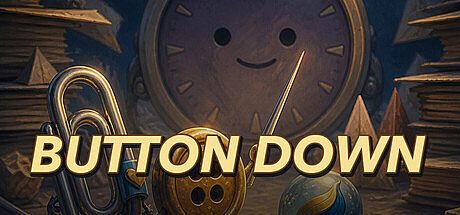




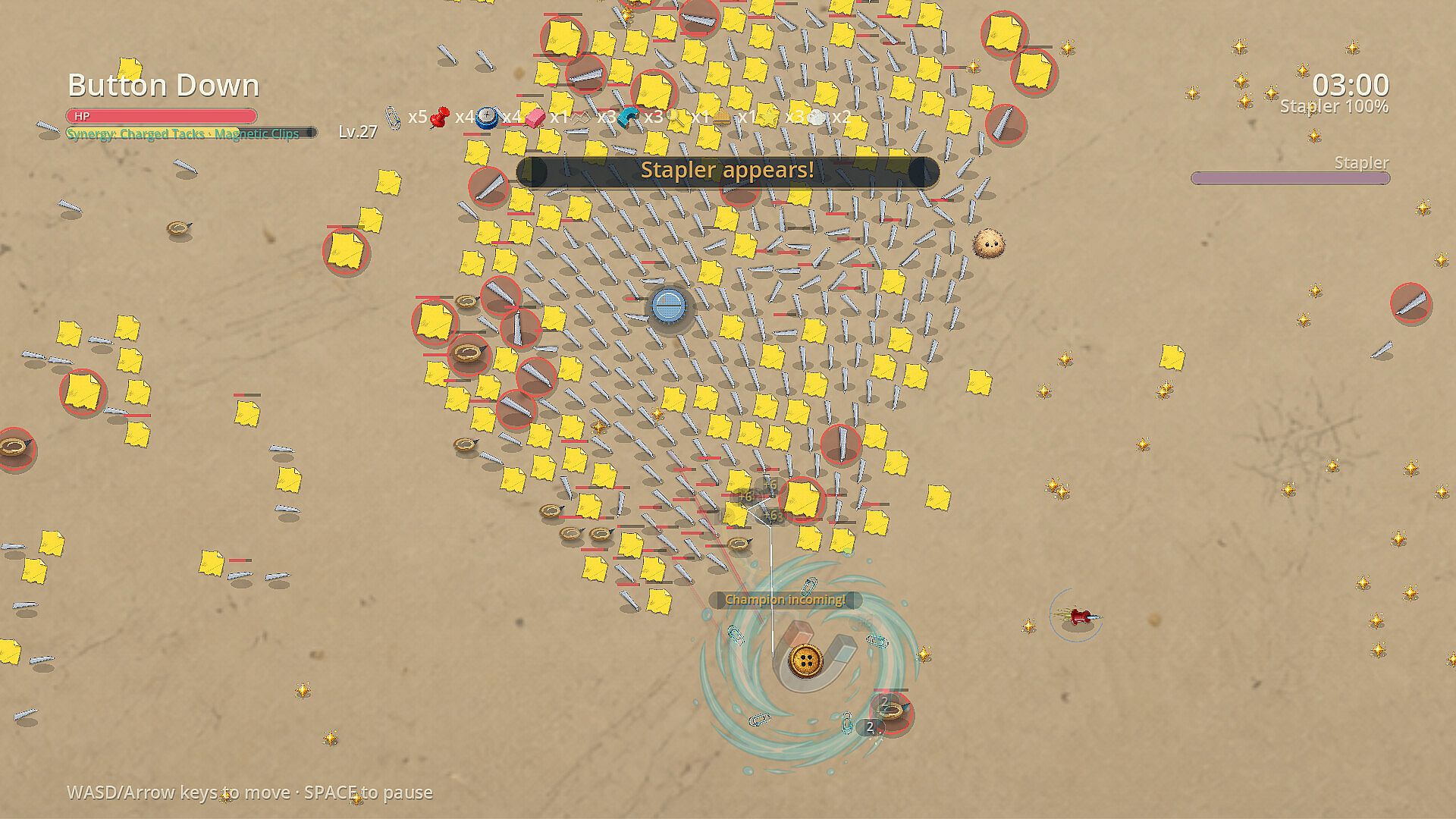
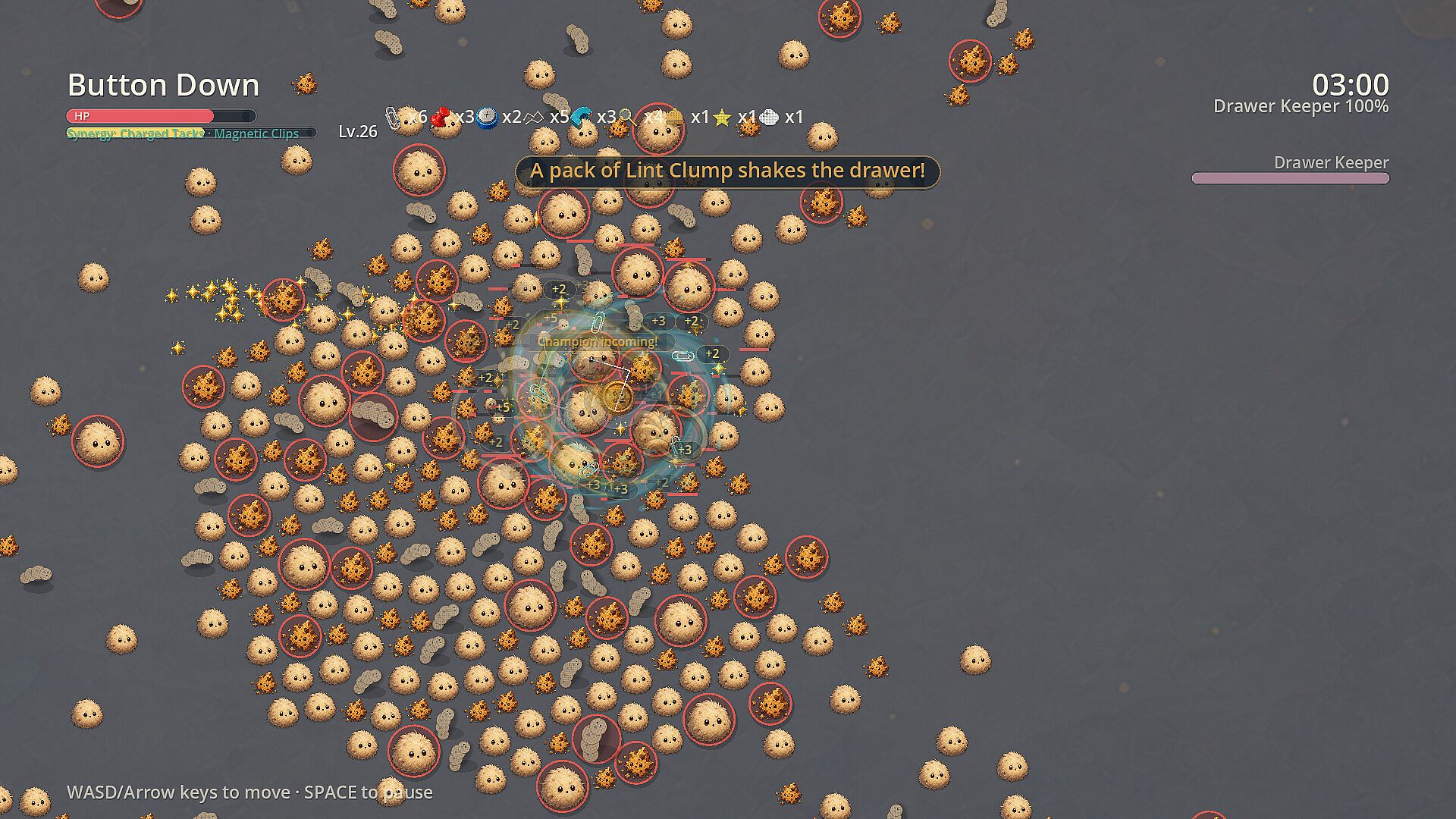
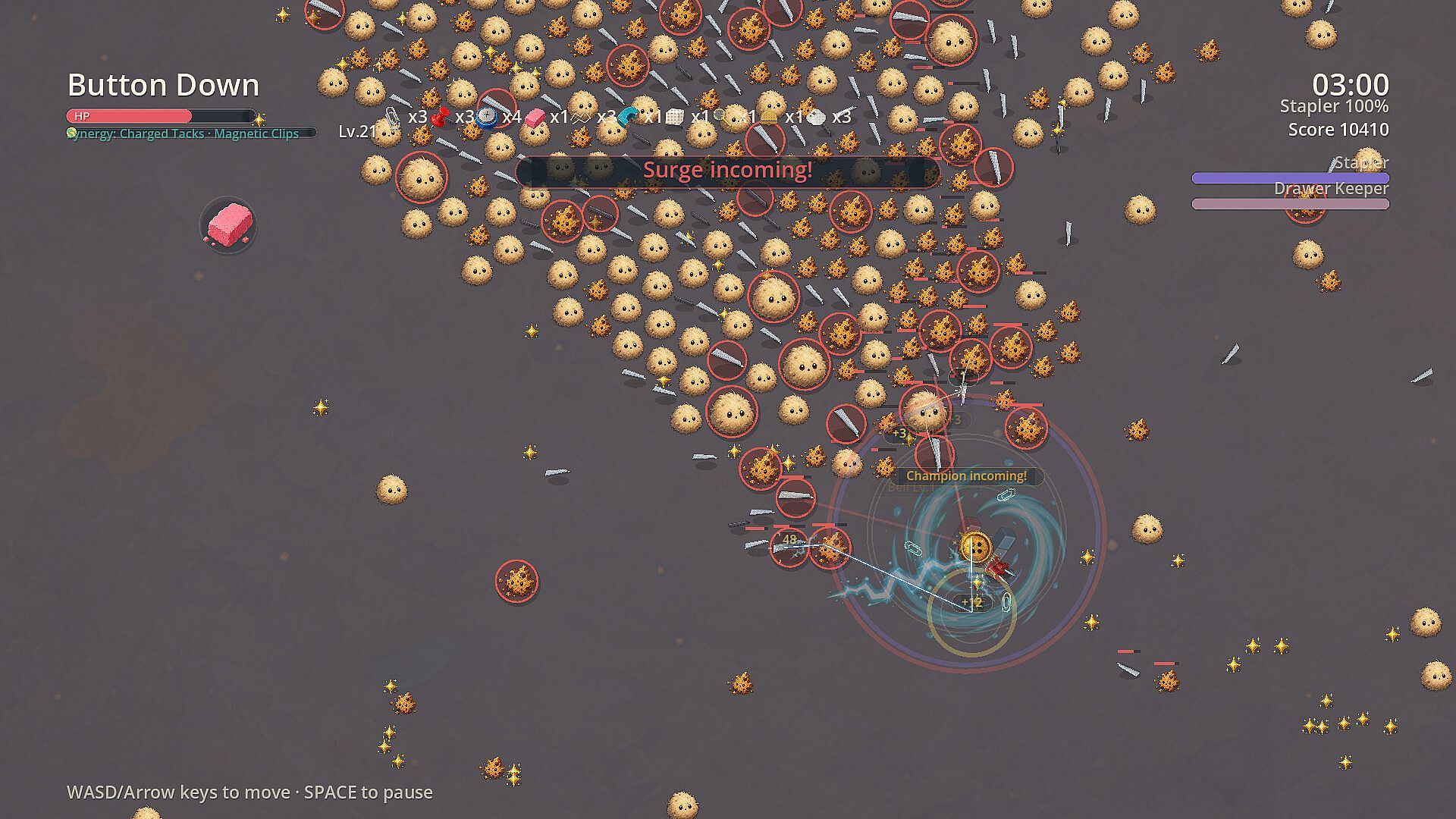
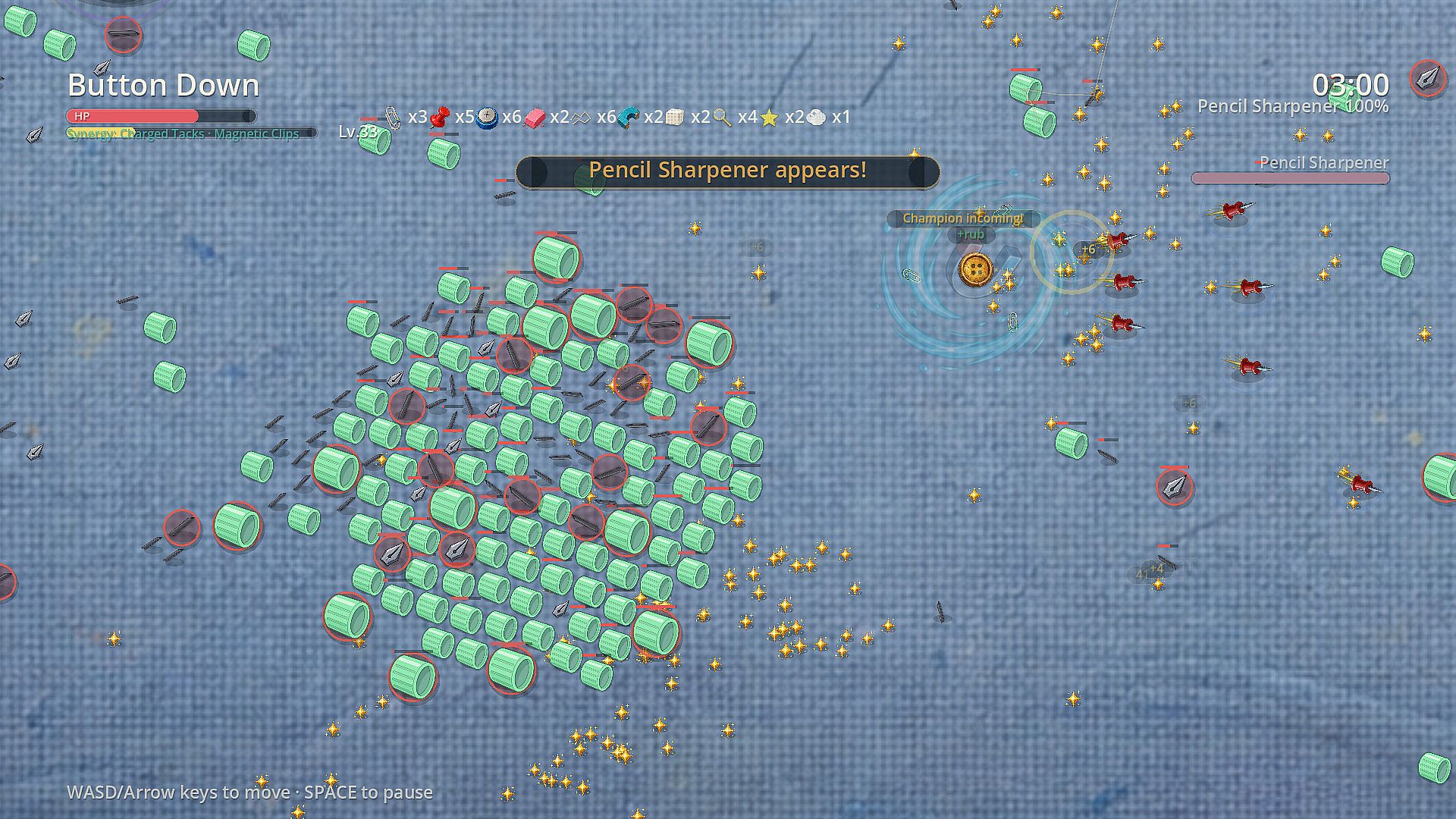
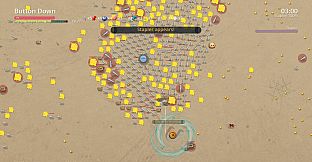
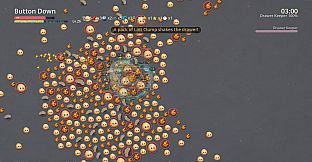
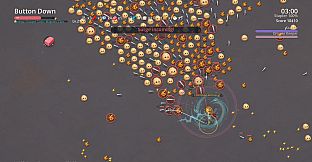
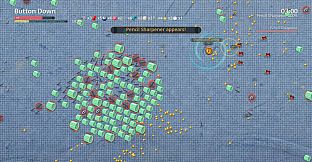
Button Down is an action indie casual survival game set in the confined space of a desk drawer. Players control a lone button navigating waves of household debris and trash that serve as both obstacles and weapons. Instead of direct attacks, the button relies on orbiting items like paperclips and firing projectiles such as thumbtacks or coins to clear threats. Positioning becomes the central skill as enemies swarm from fixed entry points on predictable timers.
Gameplay
The core loop centers on arena survival where movement and item management dictate success. A paperclip orbits the button for passive defense while thumbtacks launch forward, coins ricochet off surfaces, and button batteries create arcing damage. Supply chests, candy, and magnets appear at regular intervals, forcing players to break safe patterns to collect upgrades. Elite enemies arrive on set schedules, with stronger variants appearing every three, eight, or fourteen minutes depending on their tier.
Boss encounters introduce distinct mechanics that disrupt player positioning. Scatter pushes nearby objects outward into lanes. Sweep telegraphs a corridor before shoving everything in one direction. Spin orbits items briefly before releasing them along a tangent. Ram charges forward and interrupts control for a short duration. These effects combine with static floor hazards like eraser blocks and bottle caps that block straight paths across the arena.
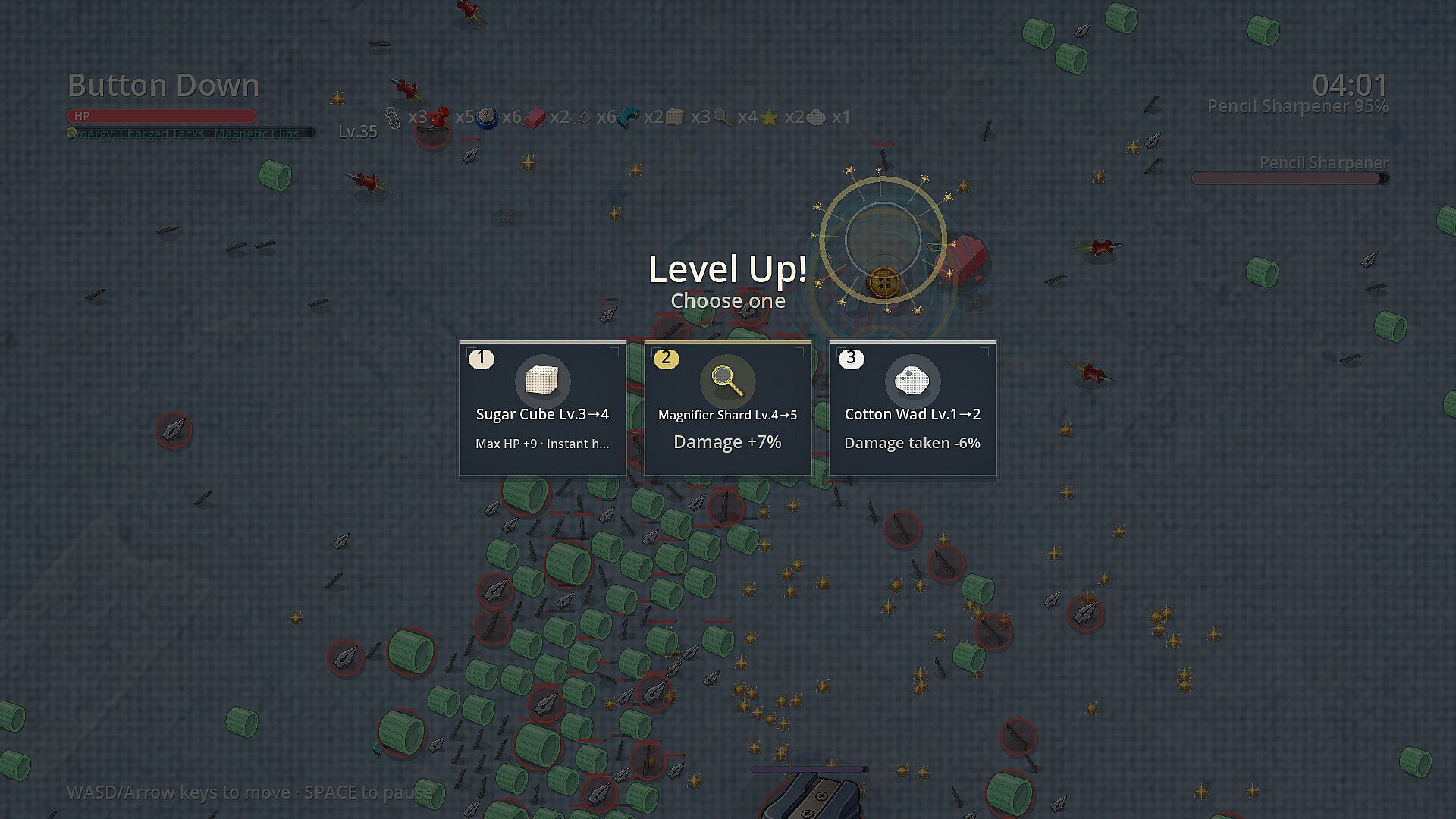
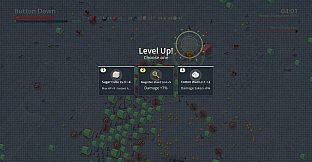
Builds reach a hard cap of six weapons and four supplies. Level-ups stop offering items once categories fill, shifting focus to deliberate choices about which upgrades to replace. Every weapon supports an evolution triggered by reaching maximum level alongside its paired supply item. Six specific synergies activate when certain weapon pairs are held together, creating named effects such as arcing hits between thumbtack and button battery or ricochet enhancements from coin and magnet shard combinations.
Game Modes
Three fixed chapters structure the main experience. Drawer introduces the basic survival loop with the boss arriving around fourteen minutes. Desk Top increases enemy power and rewards while extending the run to roughly eighteen minutes. Pencil Case further scales difficulty and length to about twenty-two minutes, requiring prior completion of Desk Top or collection of enough buttons to unlock. Each chapter delivers the same enemy layout and boss on every replay, emphasizing skill improvement over randomization.
Challenge mode provides an endless fixed-seed experience. The layout remains identical for all players, and chapter bosses cycle every three minutes. Progress continues until the button falls, with final scores submitted to a global leaderboard. This mode tests endurance and optimization without procedural changes.
Progression and Customization
Between runs, six gear slots allow minor permanent adjustments through items such as thimble, stamp, badge, wrapper, bread tag, and dice. These enhancements provide incremental advantages without creating mandatory power walls. Skins equipped on the button determine the starting weapon, offering five distinct openings including thumbtack, needle, pencil lead, coin, and glass marble.
Fourteen weapons each carry a unique evolution path, supported by eight supplies and the six synergies mentioned earlier. Twenty-eight enemy types range from minor debris like dust and crumbs to larger threats such as scissors and paper shredders. The full package includes sixteen achievements, controller support for all actions, fourteen interface languages, Steam Cloud saves, and offline play with no additional purchases required.
Is It Worth Playing?
Button Down suits players who enjoy precise positioning and pattern recognition in survival scenarios. The fixed chapter structure rewards repeated attempts to master specific boss timings and item synergies. Challenge mode adds competitive depth through its shared seed and leaderboard. Those seeking short, repeatable sessions with clear skill-based progression will find the mechanics engaging. The absence of timers in favor of boss-driven runs and the emphasis on deliberate build sacrifices create a focused experience distinct from typical endless survival titles. Availability on PC with full controller parity makes it accessible for varied play styles.