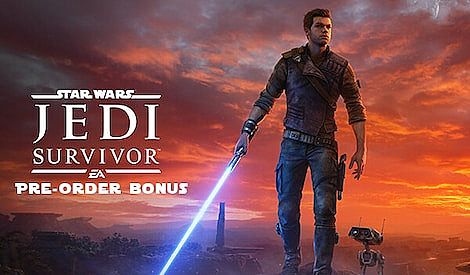








Star Wars Jedi: Survivor is a third-person single-player action-adventure game set in the Star Wars universe. Players control Cal Kestis, a Jedi Knight navigating threats from the Empire five years after the events of the previous title in the series. The experience centers on lightsaber combat, Force abilities, platforming, and exploration across multiple planets with distinct environments.
Gameplay
Combat forms the core of the experience. Cal wields a lightsaber in one of five stances that can be switched at meditation circles: single blade for balanced fighting, double-bladed for crowd control, dual wield for aggressive close-range attacks, crossguard for heavy strikes, and blaster for ranged options. Only two stances can be equipped at once, encouraging players to adapt loadouts to different enemy types and situations. A posture or guard bar system requires precise parries to break enemy defenses before landing decisive blows, while unblockable attacks demand dodging or other maneuvers.
Force powers expand tactical options. Cal can push and pull objects and enemies, slow time briefly, lift and slam foes, and confuse groups into attacking each other. These abilities integrate with combat and environmental puzzles. Traversal tools include an ascension cable for vertical movement, wall-running, double-jumping, and rideable creatures on certain planets. Larger explorable zones reward off-path discovery with collectibles, secrets, and upgrades.
Meditation circles serve as checkpoints where players rest, customize stances and skills, and respawn enemies upon leaving. Skill progression ties into survival, lightsaber, and Force trees, with points earned through exploration and combat. Five difficulty settings adjust parry timing, incoming damage, and enemy aggression to suit different playstyles. Platforming sections test timing and precision, while puzzles often combine Force powers with environmental interaction.
Game Modes
The game offers a single-player narrative campaign with no multiplayer or co-op elements. Progress follows Cal's story through linear and semi-open areas connected by the Mantis ship for travel between locations. Upon completing the main story, a New Game+ mode unlocks, allowing players to carry over progress and abilities for a second playthrough with increased challenge options.
Exploration remains consistent across the campaign. Planets feature unique biomes, enemies, and challenges that encourage thorough searching beyond the main path. No separate modes exist beyond the core story and New Game+.
Story and Characters
The narrative follows Cal Kestis as he confronts the expanding reach of the Empire while protecting his allies and remnants of the Jedi Order. New threats appear alongside familiar faces from the previous game. Decisions about how far to go in the fight against overwhelming odds shape Cal's personal arc. Voice acting, cutscenes, and environmental storytelling convey the stakes in a galaxy under Imperial control.
Supporting characters provide context and motivation. The crew dynamic aboard the Mantis adds layers to the journey without shifting focus from Cal's growth as a Jedi Knight.
Is It Worth Playing?
Star Wars Jedi: Survivor suits players who enjoy narrative-driven action-adventure games with emphasis on melee combat systems and Metroidvania-style exploration. The combat depth from multiple stances and Force integration delivers satisfying encounters, while planet traversal offers consistent discovery rewards. Patches released after launch addressed many performance concerns across platforms, including Xbox versions.
Critics generally praised the combat, level design, and story improvements over the prior entry. On Xbox Series consoles, the game runs with quality and performance modes. The Xbox One version targets 30 frames per second with reduced resolution and detail compared to newer hardware. Those seeking a focused single-player Star Wars experience with challenging fights and galaxy-spanning adventure will find the title aligns with those preferences. Availability on both Xbox One and Series platforms broadens access for different console generations.